

A Frightened Australian Shepherd Left Muddy Pawprints Across Her Pottery Studio. What Happened Next Changed Her Life.
The pottery instructor noticed the pawprints before she noticed the dog.
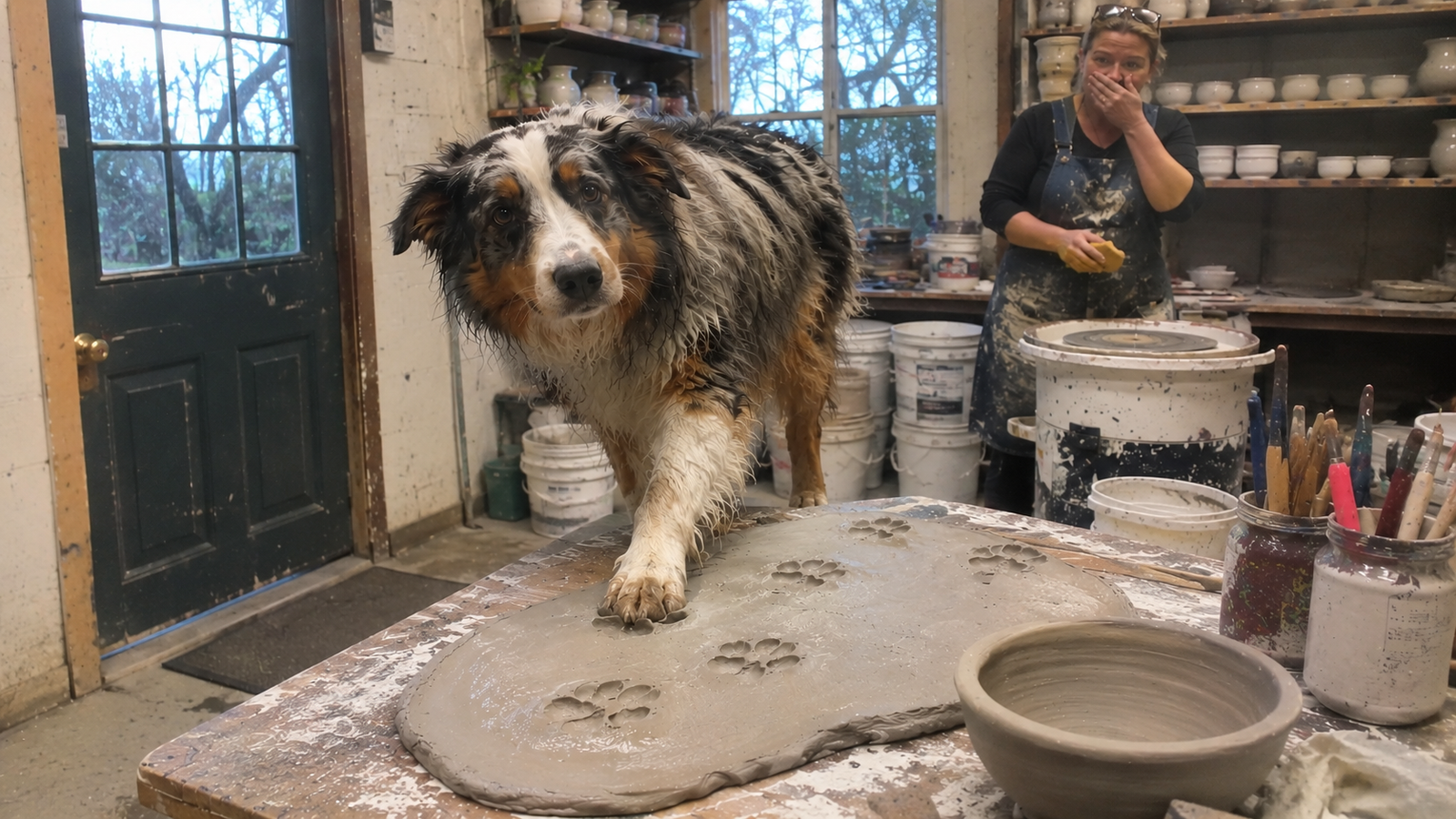
There were muddy marks across six freshly prepared clay slabs. Small streaks of dirt crossed the wooden floor, and several prints led toward the far end of the studio.
One pawprint was particularly large.
Another had landed directly in the middle of a half-finished ceramic bowl, leaving a deep impression in the soft clay.
Martha stopped walking.
She had arrived early that rainy Tuesday morning to prepare her studio for the weekend pottery class. The room should have been empty. The doors were locked, the windows were closed, and nobody was expected until noon.
Yet something had clearly been moving around inside.
She followed the muddy tracks toward a wooden workbench.
Then she saw him.
At the far end of the room, beneath the workbench, a frightened-looking Australian Shepherd was curled beside a stack of unfinished pots. His coat was wet and matted, his paws were covered in mud, and a torn piece of blue fabric hung loosely around his collar.
He was watching her.
Martha didn’t move.
For several seconds, neither of them did anything.
She had no idea where the dog had come from, how long he had been inside the building, or what had frightened him so badly that he had chosen to hide beneath a workbench.
But she could see that he was exhausted.
So instead of approaching him, Martha quietly put down her bag and began thinking about what he might need.
She found a clean bowl, filled it with water, and placed it several feet away.
Then she stepped back.
The dog looked at the bowl but didn’t move.
Martha waited.
She didn’t try to reach under the workbench or call him toward her. Whatever had happened before he arrived at the studio, she didn’t want to make him more frightened.
Eventually, she contacted animal control.
By the time a rescue officer arrived, the dog was still hiding in the same place.
It took patience to bring him out safely.
Nobody knew his name.
Nobody knew where he belonged.
And nobody at the studio could have imagined that the muddy pawprints he had left behind would eventually become one of the most meaningful decorations in the entire building.
A Rainy Morning Outside Asheville
The pottery studio was located in a small town outside Asheville, North Carolina.
It wasn’t a large commercial workshop. It was a modest space where people came to learn pottery, work with clay, and spend a few quiet hours away from their usual routines.
Martha owned and operated the studio.
She taught classes during the week and organized occasional weekend workshops for beginners. Some visitors had experience working with ceramics, while others had never touched a pottery wheel before.
The building had a welcoming, slightly imperfect character.
Wooden shelves held finished bowls, cups, plates, and decorative pieces. Along the walls were containers filled with brushes, carving tools, and other equipment. Several workbenches were marked with years of use, and the pottery wheel stood near a large window that allowed natural light into the room.
Martha liked things that carried signs of having been used.
A handmade bowl did not need to be perfectly symmetrical. A small irregularity in the surface could make a piece feel more personal.
She often reminded her students that working with clay required patience.
You couldn’t rush the material.
You couldn’t force it into the shape you wanted without understanding how it behaved.
That morning, she would discover that the same lesson applied to a frightened dog.
The rain had been falling since early morning. The roads were wet, the air was cool, and the town seemed quieter than usual.
Martha had planned to prepare several clay slabs before the weekend classes.
She unlocked the studio, switched on the lights, and entered with her usual list of things to accomplish.
Then she saw the footprints.
At first, she thought someone had accidentally walked through the studio with muddy shoes.
But the marks were too clearly shaped.
They were pawprints.
And they weren’t all the same size or direction. Some crossed the floor, while others appeared around the workbenches.
When Martha noticed the bowl with a pawprint pressed into its center, she knew there was an animal inside.
She followed the tracks and discovered Jasper before she even knew his name.
The Dog Beneath the Workbench
The Australian Shepherd looked as though he had been outside for quite some time.
His coat was dirty, and parts of it were tangled with dried mud. His body appeared thin, although it was difficult to judge his condition while he remained curled up beneath the workbench.
The torn blue fabric around his collar caught Martha’s attention.
It looked like a piece of material that had become caught on something and pulled loose.
There was no clear identification attached to it.
The dog didn’t growl or show his teeth. He simply watched Martha with cautious eyes, keeping his body close to the ground.
She had encountered nervous animals before, but she understood that every animal responded differently to an unfamiliar situation.
She also knew that a dog who had been frightened or lost could react unpredictably when approached.
So she gave him space.
She moved slowly, avoided making sudden movements, and placed the water bowl where he could reach it without having to come directly toward her.
For a while, he remained still.
Martha continued preparing for the rescue officer’s arrival, keeping an eye on him without constantly staring.
Eventually, the officer managed to bring the dog out safely.
Before leaving, Martha looked once more at the damaged work on the floor.
Six clay slabs had muddy marks across them. One bowl had been stepped on, and several smaller pieces needed to be cleaned or prepared again.
Normally, discovering that much damage would have been frustrating.
But as she watched the dog being taken to safety, she found herself caring very little about the pottery.
The dog had needed somewhere to hide.
For whatever reason, her studio had become that place.
At the Shelter, They Gave Him a Name
The dog was taken to a nearby animal shelter.
The staff began the usual process of checking his condition and making arrangements to care for him while they tried to identify an owner.
They estimated that he was approximately five years old.
He was friendly once he became comfortable with people, but sudden movements seemed to frighten him.
He would approach cautiously, observe what was happening around him, and retreat whenever something felt unfamiliar.
The shelter staff noticed that he seemed more comfortable when people allowed him to make the first move.
They decided to call him Jasper.
It was a simple name for a dog whose identity was still a mystery.
For now, the shelter needed to provide him with a safe environment and give him time to settle.
He was no longer sitting beneath a workbench in a strange building, but that didn’t mean he immediately understood that he was safe.
A new place can be difficult for a dog, particularly when everything smells different and the people around him are strangers.
The shelter workers gave him space and tried to establish a comfortable routine.
They made sure he had access to food and water, and they continued observing his behavior.
Jasper gradually became more comfortable.
But someone outside the shelter had already begun thinking about him.
Martha couldn’t stop remembering the muddy Australian Shepherd who had appeared in her studio.
She kept thinking about the torn blue fabric around his collar and the way he had watched her from beneath the workbench.
She also wondered whether he had been wandering for days before finding his way inside.
Most importantly, she wondered what had happened to him.
Martha Couldn’t Stop Thinking About Jasper
Over the next few days, Martha returned to her normal routine.
She cleaned the studio, prepared fresh clay, organized the shelves, and continued getting ready for the weekend pottery class.
But something about the workshop felt different.
She would occasionally look toward the wooden workbench where Jasper had been hiding.
The muddy tracks had been removed, and the damaged pottery had been set aside. The studio looked almost exactly as it had before that rainy morning.
Yet Martha continued remembering the dog.
She eventually decided to visit the shelter.
She didn’t know whether Jasper would remember her or even recognize the studio owner who had found him.
Still, she wanted to see how he was doing.
When she arrived, she brought a small piece of dried clay.
It wasn’t a toy or a treat.
It was simply a familiar material from the place where she had found him.
The shelter worker helped arrange the meeting.
Jasper was brought into the room, and Martha waited quietly.
At first, he approached cautiously.
He looked at her, then at the unfamiliar surroundings.
Martha placed the piece of dried clay on the floor.
Jasper lowered his head and sniffed it.
He examined it for a moment.
Then, gently, he touched it with one paw.
Martha smiled.
It was a small gesture, but it brought back a memory she had not expected to revisit.
She began telling the shelter worker about her father.
The Memory of Her Father’s Workshop
Martha’s late father had been a ceramic artist.
For much of his life, he had spent his days working with clay. His workshop had been a place filled with unfinished pottery, tools, shelves, and the quiet sounds of someone creating something by hand.
Martha remembered visiting him there.
She remembered the smell of wet clay, the feeling of the workshop floor, and the way he could spend hours concentrating on a single piece.
He rarely seemed to be in a hurry.
To him, pottery was not simply about producing bowls or cups. It was about understanding the material and allowing each piece to develop.
There had also been a dog in his workshop.
The animal used to lie near the pottery wheel while he worked.
It was a familiar part of those mornings. Her father would concentrate on the clay, while the dog rested nearby, occasionally lifting its head whenever he moved around the room.
The dog didn’t need to participate.
Just having it there made the workshop feel less empty.
Martha had grown up around those small routines.
After her father died, she inherited many of his old studio tools.
She kept them carefully, preserving equipment that carried years of memories. Some of the tools remained arranged much as they had been in his workshop.
She had continued working with pottery herself, but something had changed.
There were days when using his tools brought back so many memories that she found it difficult to concentrate.
She had never completely stopped creating, but she had struggled to return to the same regular routine.
Seeing Jasper had unexpectedly reminded her of those mornings.
The way he had chosen to lie beneath the workbench.
The way he had quietly watched the room.
The image of a dog resting near a pottery wheel came back to her.
For the first time in a long while, Martha could imagine the workshop feeling that way again.
She looked at Jasper.
And an idea began to form.
Martha Decided to Foster Him
Martha knew she couldn’t make an emotional decision without considering what Jasper needed.
She had a business to manage, pottery classes to teach, and responsibilities that required her attention.
Adopting a dog was a serious commitment.
She also understood that Jasper had already experienced enough disruption.
He needed stability, patience, and a place where he could gradually become comfortable.
She discussed the possibility of fostering him with the shelter staff.
After considering the arrangement, she decided to bring him home temporarily.
The intention was to give him a safe environment and see how he adjusted to life in the studio.
Martha didn’t know exactly how long the process would take.
She didn’t expect Jasper to immediately become comfortable around the pottery wheel or behave as though he had always belonged there.
She simply wanted to give him a chance.
When Jasper arrived at the studio again, he seemed uncertain.
He recognized the surroundings through their smells and familiar layout, but the experience was different from the first time.
Previously, he had entered the building without anyone knowing where he came from.
Now, Martha had intentionally brought him there.
She prepared a comfortable place for him near the wooden workbench.
There was water nearby, and she made sure he had enough space to move around without feeling trapped.
Jasper spent much of his first few days near the studio door.
He didn’t seem interested in exploring the entire room.
Whenever Martha moved around, he watched her.
Sometimes he would follow her for a short distance before returning to his preferred spot.
Martha allowed him to settle at his own pace.
She never dragged him toward the pottery wheel or tried to make him interact with the tools.
She simply continued working.
And slowly, Jasper began to understand that the studio was a place where he could rest without being disturbed.
The Pottery Wheel Became Part of His New Routine
Martha began noticing small changes.
Jasper started sleeping beneath the workbench instead of remaining beside the door.
He became more comfortable with the sounds of the studio.
The movement of wooden stools no longer caused him to immediately retreat. He appeared less concerned when Martha picked up tools or carried pieces of pottery from one table to another.
He also began following her around.
When she walked toward the shelves, Jasper would sometimes get up and follow.
When she moved toward the pottery wheel, he watched from a short distance.
Martha didn’t make a big deal out of these changes.
She understood that confidence was not something that appeared all at once.
It developed through repeated experiences.
For Jasper, the studio was gradually becoming familiar.
He could recognize where the water bowl was kept, where he could rest, and where Martha usually spent her time.
He also learned that she wouldn’t force him into situations that frightened him.
Their days began developing a comfortable rhythm.
Martha would arrive, prepare her materials, and begin working.
Jasper would settle beneath the workbench.
Occasionally, he would get up and walk around the room before returning to his resting place.
The pottery wheel continued turning.
Clay was shaped, trimmed, and prepared.
And the Australian Shepherd who had once hidden beneath a stranger’s workbench was now quietly accompanying Martha through her working day.
She hadn’t planned for any of this.
But the studio was beginning to feel different.
One Afternoon, Jasper Made His Own Contribution
The moment Martha remembered most clearly happened one afternoon.
She was preparing a large piece of clay.
It was a fresh surface, soft enough to be shaped by hand and ready for the next stage of her work.
Jasper was nearby.
He had become comfortable enough to move around the studio, although he still preferred to stay close to the workbench.
On this particular afternoon, he approached Martha.
She noticed him looking at the clay.
He lowered his head and sniffed the wet surface.
Martha paused.
She watched him carefully, wondering what he was going to do.
Then Jasper lifted one paw.
And placed it directly in the middle of the clay.
For a second, Martha simply stared at the print.
Then she laughed.
It was not a perfect decorative impression.
It wasn’t something she had planned or intended to create.
It was simply a pawprint left behind by a dog who had been curious about what she was doing.
But to Martha, it meant something much more.
She looked at the little impression in the clay.
The shape was clear enough to recognize.
The edges of the paw had pressed into the soft surface, leaving a small record of Jasper’s presence.
And suddenly, the memory of her father’s workshop came back again.
She remembered the dog that used to lie beside his pottery wheel.
She remembered the quiet mornings when her father worked and the animal rested nearby.
For the first time since her father’s death, the studio didn’t feel so quiet.
Martha smiled at Jasper.
He looked up at her, apparently unaware of how meaningful the moment had become.
She carefully moved the piece of clay aside.
She didn’t want the pawprint to be damaged or accidentally flattened during the next stage of her work.
She decided to keep it.
A Pawprint That Became More Than a Decoration
Martha had created countless pieces of pottery over the years.
Some were functional.
Others were decorative.
A few had been made simply because she wanted to experiment with a particular shape or texture.
But this piece was different.
It had not started with a design or a specific plan.
It had happened naturally.
Jasper had approached the clay, inspected it, and left his mark.
Martha carefully preserved the impression.
She didn’t rush to turn it into a finished piece. She wanted to keep the original shape of the pawprint without losing the small details.
It became something personal.
For years, her father’s tools had remained in the studio, carrying memories of the person who had taught her so much about working with clay.
Now, Jasper had left something of his own.
It was a small connection between the life Martha had known before and the new routine slowly developing around her.
She could look at the pawprint and remember the rainy Tuesday morning when a frightened dog had appeared in her workshop.
She could remember his cautious expression beneath the workbench.
And she could remember the afternoon he finally approached her without fear.
The piece eventually became a small decoration.
Martha placed it beside the studio’s entrance.
It wasn’t particularly large or elaborate.
Visitors didn’t need to understand its story simply by looking at it.
But Martha knew what it represented.
It was a reminder of the dog who had unexpectedly become part of her life.
Jasper Started Feeling at Home
Over the following weeks, Jasper became more confident.
His routine became increasingly familiar.
He began sleeping beneath the workbench as though it had always been his preferred place.
He followed Martha around the studio and became comfortable with the ordinary sounds of her work.
He was no longer the frightened dog who had tried to remain invisible beneath the furniture.
He still had moments when something unfamiliar made him cautious, but he seemed more relaxed in his surroundings.
Martha also began noticing that his presence had become important to her own routine.
Before Jasper arrived, she often worked alone.
The studio was quiet except for the sounds of pottery equipment, the movement of materials, and the occasional footsteps of someone preparing a class.
She had become accustomed to that silence.
Now there was another presence.
Sometimes Jasper would lie near the wheel while she worked.
Other times, he would move to the doorway and watch people entering the room.
He didn’t need to do anything special.
He didn’t need to entertain her.
Just knowing he was nearby brought a sense of companionship that Martha hadn’t realized she was missing.
Her father’s old tools were still on the shelves.
The pottery wheel was still in its familiar position.
But the room no longer felt quite the same.
It had become a shared space.
And the dog who had once arrived covered in mud was now becoming part of the daily life of the studio.
The Foster Dog Became a Permanent Member of the Family
As the weeks passed, Martha became certain about what she wanted.
She didn’t want Jasper to move to another home.
She wanted him to stay.
She completed the process to adopt him, giving the Australian Shepherd a permanent place in her life.
For Jasper, the change meant that the studio was no longer a temporary stop.
It was home.
He had a person who understood that he needed patience and a familiar environment.
He had a comfortable place to rest.
And he had the freedom to spend his days beside someone whose work naturally suited the quiet companionship he had come to enjoy.
Martha continued teaching pottery classes.
Jasper remained part of the studio routine.
He became a familiar presence to the people who visited, although he was never expected to perform or entertain anyone.
Some students noticed him resting beneath the workbench.
Others saw him quietly following Martha between the shelves.
The pawprint beside the entrance eventually became a small conversation piece.
People would stop and look at it.
They noticed the shape and wondered why Martha had decided to preserve such an unusual decoration.
Eventually, someone would ask about it.
Martha always gave the same answer.
“That’s Jasper. He was the first student who didn’t need a lesson.”
It became a little story she enjoyed telling.
And every time she told it, she remembered how unexpectedly the whole thing had begun.
The Photograph That Told the Story
A few months after Jasper’s arrival, Martha decided to send the shelter an update.
She wanted the staff to know what had happened to the dog they had once named and cared for.
She took a photograph of Jasper sleeping beside the pottery wheel.
He looked completely comfortable.
His body rested against the floor, and his paws had a little dried clay on them.
There was no sign of the frightened dog who had once hidden beneath the workbench.
The studio looked familiar around him.
The pottery wheel stood nearby, and the room held the same tools and materials that had been part of Martha’s daily work for years.
But now Jasper was part of the picture too.
Martha sent the photograph to the shelter with a short message.
“He still makes a mess. I think Dad would have liked him.”
It was a simple note.
But it carried a lot of meaning.
The shelter had first met Jasper as a dog who needed somewhere safe to go.
They had given him a name, cared for him, and helped him find a foster home.
Now they were seeing him settled beside the person who had first discovered him.
For the staff, the photograph was a reminder of how much a dog’s circumstances could change.
When Jasper arrived, nobody knew where he belonged.
Martha hadn’t even known he was inside her studio until she noticed the pawprints.
Now, months later, the same dog was sleeping peacefully beside her pottery wheel.
The Pawprint Still Welcomes Visitors
The small decoration remained beside the studio entrance.
It was one of the first things some visitors noticed when they came inside.
They sometimes assumed it was a specially designed ceramic piece or a decorative pattern created by Martha.
But when they asked about it, she explained that it had been made by Jasper.
A few people laughed when they heard the story.
Others looked toward the workbench, where Jasper could often be found resting.
Martha enjoyed telling them that he had left his mark before she ever knew his name.
She would explain how he had arrived during a rainy Tuesday morning, how he had been frightened, and how his pawprint had accidentally become one of the most meaningful objects in the studio.
The story was not about a perfect piece of pottery.
It was about an unexpected visitor who had gradually become part of a home.
Martha continued using her father’s tools.
She continued teaching classes.
And she continued working with clay, sometimes with Jasper resting close enough that she could hear him breathing.
There were still days when she missed her father.
A familiar tool or an unfinished piece of pottery could bring back memories.
Jasper hadn’t taken those memories away.
He hadn’t replaced the person she had lost.
But his presence had brought something new into a space that had once felt difficult to return to.
The studio was no longer only a place where she preserved the past.
It had become a place where new memories were being made.
And sometimes, while working at the pottery wheel, Martha would glance toward the workbench and see Jasper sleeping in his usual spot.
She would smile.
Then she would return to her clay.
A Small Mark That Changed Everything
Looking back, Martha could have easily remembered that Tuesday morning as the day a stray dog damaged six clay slabs and stepped into a half-finished bowl.
That was how the story had begun.
A muddy animal had entered a pottery studio, left footprints across freshly prepared clay, and hidden beneath a wooden workbench.
But the damaged pottery was never the important part.
The important part was what happened afterward.
A frightened dog was given patience instead of pressure.
A woman who had struggled to return to her late father’s work found a reason to enjoy the studio again.
And a small pawprint became a reminder that sometimes the most meaningful things are not planned.
Jasper had not arrived with a name, a known history, or a guaranteed place to stay.
He had arrived wet, exhausted, and uncertain.
Martha had not been looking for a dog.
She had simply been preparing her studio for a pottery class.
Yet their paths crossed on a rainy morning, and neither of their lives remained quite the same.
The little ceramic pawprint still sits beside the entrance.
People continue asking whose it is.
And Martha continues giving the same answer.
“That’s Jasper. He was the first student who didn’t need a lesson.”
Somewhere in the studio, Jasper is usually resting beside the pottery wheel.
His paws occasionally collect a little dried clay.
And Martha suspects that if her father could see the workshop now, with the old tools still in use and a familiar kind of four-legged company beside the wheel, he would have smiled.
