The Groomer Stopped Mid-Haircut When Pippa Fell Asleep in Her Hand
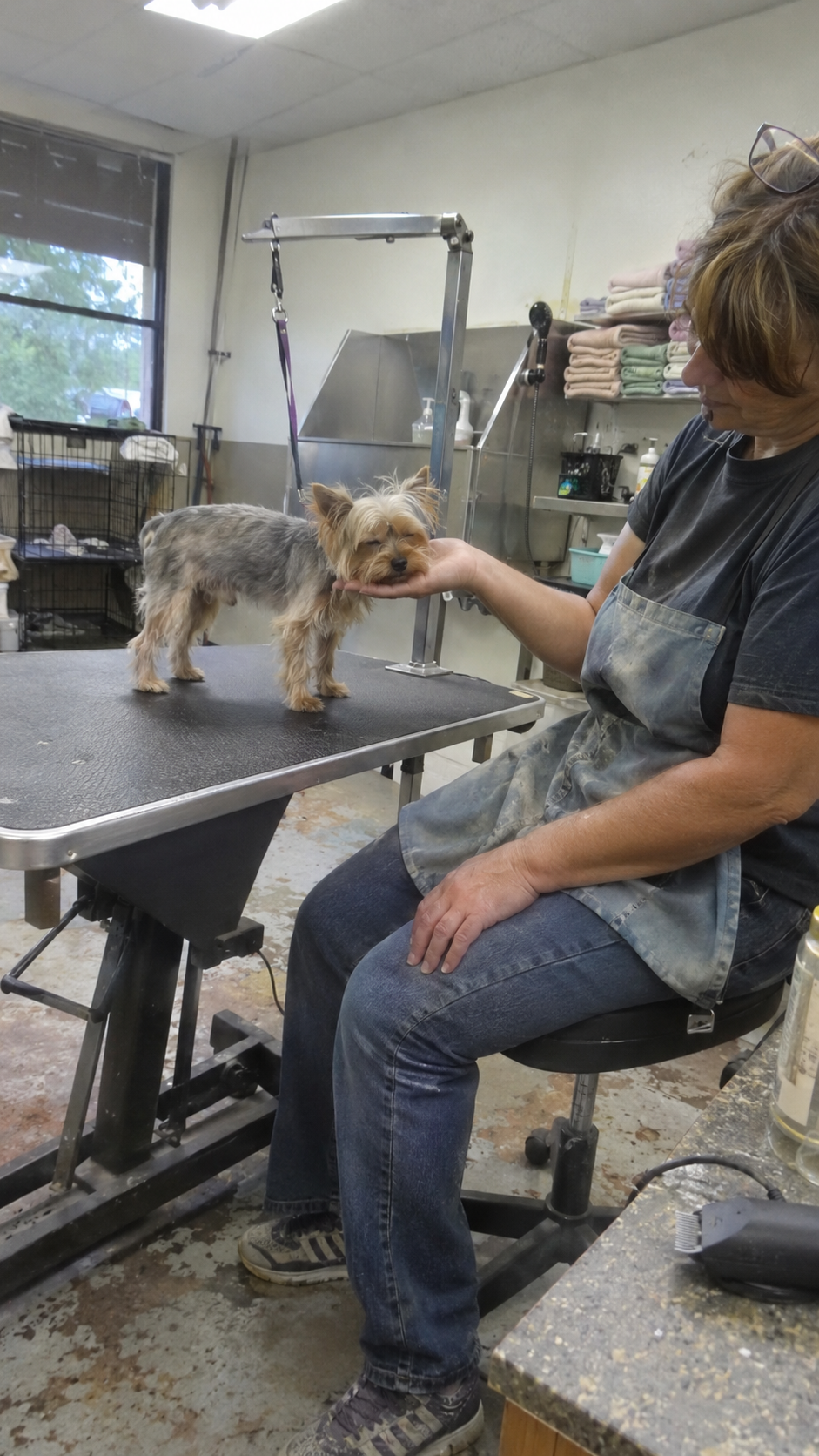
Halfway through Pippa’s haircut, Angela found herself unable to move her left hand.
There was nothing wrong with it. She could have drawn it back, reached for a comb, or adjusted the little dog standing on her grooming table. But Pippa had lowered her chin into Angela’s palm, and somewhere between one careful pass of the clippers and the next, she had fallen asleep.
Angela switched off the clippers.
I was sitting near the door. From there, I could see the uneven tufts around Pippa’s face and the way her eyes had finally closed. Angela kept her hand exactly where it was.
For a moment, neither of us spoke.
Then she glanced toward me.
“Could you reach my stool?”
I pushed it over with my foot. Angela eased herself onto it, still supporting Pippa’s head.
There were things left to do. There always were in a grooming salon. But for the next few minutes, the haircut could wait.
A Small Dog With an Unfinished Haircut
Pippa was a five-year-old Yorkshire Terrier who had come into our rescue near Greenville, South Carolina. She weighed six pounds, small enough that a folded towel made a substantial place for her to sit.
Her coat had been badly neglected.
The veterinary team had already dealt with the painful matting before we took her to Angela. That necessary work had left her looking uneven: patches clipped close, longer pieces elsewhere, and tufts around her face that made it difficult to see her eyes clearly.
There was no reason to hurry her into looking polished. What she needed first was to be comfortable, and the veterinary team had addressed the most urgent part of that.
Still, there was more care ahead. The remaining coat needed gentle attention. Her face needed cleaning. Eventually, she would need a manageable haircut that could be kept tidy as she moved toward adoption.
We wanted that work done by someone willing to notice when she had had enough.
Angela usually saw dogs whose owners came prepared to discuss the details. There were conversations about how much length to leave on ears, whether feet should be rounded, and how closely a trim should follow the last one.
Pippa arrived with a volunteer and a towel.
The instructions were simple: stop whenever she needed a break.
No one expected Angela to finish everything in one appointment. We did not know how much Pippa would tolerate, and there was little to be gained by finding out through persistence.
Angela listened, looked at the small dog in front of her, and began with what seemed possible.
Twenty Minutes Was Enough
Pippa’s first visit lasted twenty minutes.
It would have been easy to look at her afterward and think very little had happened. She still had an uneven coat. There were still longer pieces around her face. Anyone expecting the usual before-and-after transformation would have been disappointed.
Angela had cleaned her face with a damp cloth.
Pippa had watched the door.
That was the shape of the appointment: a small, useful act of care while Pippa kept track of the way out.
Angela worked close to her, bringing the cloth to the places that needed it without turning the visit into a struggle to accomplish more. There was no need to produce a finished dog at the end of those twenty minutes. There was only the question of how much could be done comfortably that day.
For a dog who weighed six pounds, a grooming table held a great deal of unfamiliar equipment and movement. Hands reached near her face. Objects were picked up and put down. Beyond the table, the salon continued its ordinary business.
Pippa kept looking toward the door, where the volunteer would eventually carry her out.
We could not know everything she made of the visit. Her attention gave us something concrete to respect, though. Whatever else was happening, she was not ready to stop watching her surroundings.
When the appointment ended, Angela let it end.
There was no final push to tidy one more patch or get the face looking better before Pippa left. The damp cloth had done its work. The rest could be left for another day.
That gave us a sensible starting point for the next visit. We knew what she had accepted, and we knew that Angela was willing to work within it.
Another Go Next Time
At the second appointment, Pippa accepted a little brushing.
It was modest progress, the sort that might disappear in a quick account of a rescue dog’s recovery. There was no dramatic change in her appearance. But Angela was able to do something that had not been part of the first short visit.
For a while, Pippa allowed it.
Then she became restless.
On a grooming table, there is a temptation to negotiate with those last few minutes. A little more brushing might make the next appointment easier. One small section might be nearly finished. Stopping can feel inconvenient when the tools are already in hand.
Angela put everything down.
The volunteer lifted Pippa and carried her outside. The appointment was over before the brushing had become something they had to get through together.
“She’ll have another go next time,” Angela said.
There was no disappointment in the way she said it. She had seen that Pippa needed to stop and had stopped. Another appointment was already a reasonable possibility.
For those of us caring for Pippa, that mattered. We were trying to prepare her for a home where grooming would remain part of her life. A Yorkshire Terrier’s care would not be completed by a single haircut, however tidy it looked.
She would need to return to a table. Someone would need to clean around her face and attend to her feet. Those ordinary tasks would be easier if they could happen without every visit becoming a test of endurance.
Angela had room in her approach for an unfinished job.
She could put down the brush while there was still brushing to do. She could allow the volunteer to leave with a dog who looked much as she had on arrival.
By the third visit, we had learned something useful about Angela as well as Pippa: when the instructions said to stop, she meant to follow them.
The Third Visit
I was there for the third appointment, sitting near the door.
Pippa was on the table, and Angela was working through the haircut in careful stages. Her left hand rested beneath Pippa’s chin, supporting her head while she attended to the coat around it.
At first, there was nothing especially remarkable about the position. A groomer steadies a small dog. A dog allows a hand beneath her jaw. The work continues.
Then Pippa’s eyes began to close.
Angela kept her palm in place. Pippa’s chin settled into it with a little more weight.
I watched without saying anything. It seemed better to let the moment continue without calling attention to it. Angela noticed too, and her movements became still.
The clippers went quiet.
Pippa was asleep.
This was the dog who had watched the door through her first appointment. At the second, a little brushing had been enough before she needed to leave. Now, in the middle of a haircut, she had stopped keeping track of the room.
We did not need to decide what that meant beyond what we could see. Her eyes were closed. Her head was resting in Angela’s hand. She was comfortable enough to remain there.
Angela could have moved her. She could have shifted her grip and continued with the coat. Instead, she stood for a moment, caught in the practical difficulty of having become a sleeping dog’s chin rest.
That was when she asked for the stool.
I pushed it across with my foot so she would not have to move away from the table. She sat down carefully, keeping her left hand beneath Pippa’s head.
The solution was so simple that it almost made me smile. Pippa needed to sleep. Angela needed to sit. Once the stool was in place, both could do what they needed.
There was nothing else for us to arrange.
Fifteen Minutes in a Busy Salon
Angela sat like that for nearly fifteen minutes.
The salon did not fall silent around them. The other groomer answered the telephone. In the next room, a Labrador complained about his bath.
Pippa slept through all of it.
The telephone brought its ordinary interruption, a voice answering and carrying on with the day’s business. The Labrador made his opinion known. Elsewhere, there were appointments to finish and owners who would return for their dogs.
At Angela’s table, the work had paused.
From my chair near the door, I could see how little she was doing. She was sitting on a stool with one hand held beneath a six-pound dog’s chin.
It required patience, and it required staying in a position she had not chosen for herself. There was no useful way to fill the interval with another task. The hand Pippa had settled into was occupied.
Angela let it remain occupied.
The haircut was still unfinished, but that no longer seemed like the most relevant thing about the appointment. For nearly fifteen minutes, Pippa stayed asleep while the room carried on around her.
We did not whisper over her about everything she must have experienced. We did not turn those minutes into a promise about how she would behave from then on. A nap could be allowed to be a nap.
It was still a change worth noticing.
On her first visit, Pippa had kept her eyes on the door while Angela cleaned her face. On this visit, she had closed them while Angela held her head.
Those were small actions, but they were the actions we had.
When she was ready to continue, the remaining care could be considered again. There would still be a face to tidy and a coat to make practical. Angela had not forgotten why Pippa was there.
She had simply allowed something else to take precedence for a while.
Ready for a Home
By the time Pippa was ready for adoption, her coat was short and practical.
The long tufts around her face had been tidied. You could see her eyes.
She did not need an elaborate style. She needed a coat that could be cared for, with the uneven remnants of the earlier clipping brought into something comfortable and manageable.
The result suited the next part of her life.
A woman named Rachel took her home.
As we did with any adoption, we explained Pippa’s care and passed on her records. There were practical details to go through, things Rachel would need after the excitement of bringing her home had settled into daily life.
We also gave her Angela’s number.
It was useful information to pass along with everything else. Angela had already worked with Pippa across three visits. She had cleaned her face, done a little brushing, stopped when she became restless, and held her chin while she slept.
Rachel would not have to find a groomer without any knowledge of how Pippa might respond.
Of course, going home with Rachel did not mean every new situation would immediately become easy. Pippa could be ready for adoption and still need time with unfamiliar people. The care she had received could help her move forward without settling every uncertainty at once.
What mattered was that Rachel had the information we could give her.
The veterinary records belonged with her. So did the details of her ongoing care. Angela’s number was one more connection Rachel could use as she learned what worked for the little dog now living with her.
Pippa left the rescue with her face clear and her next chapter beginning.
For a while, Angela’s part in that chapter waited between appointments.
Six Weeks Later
Six weeks after the adoption, Rachel booked Pippa a tidy-up.
It was an ordinary reason to return. Her coat needed attention again, and Angela’s number was there to call.
Rachel brought her through the salon door. Pippa paused to sniff the floor, taking in the room at her own level.
Then she pulled toward Angela.
The movement was clear enough that there was no need to guide her across. Angela was where Pippa wanted to go.
Angela crouched just enough to greet her. Pippa came close and stood against her shoe, waiting to be lifted.
Rachel looked surprised.
“She’s usually cautious with new people.”
“We’ve met,” Angela said.
It was a brief answer, and it explained what Rachel was seeing. To Rachel, this was the groomer whose number the rescue had provided. To Pippa, Angela was already familiar.
There was a history in the room that had begun before the adoption.
It included a damp cloth and a short first appointment. It included a brush being put down when Pippa became restless. It included a stool pushed across the floor so Angela could sit without disturbing her.
Rachel had not been there for those moments. She was seeing their place in Pippa’s life through the little dog’s greeting.
Angela lifted her onto the table.
There was no need to recreate the earlier appointments or expect another nap. This was a new visit, with Pippa arriving from home and Rachel able to see how she responded.
Angela offered her hand beneath Pippa’s chin.
Pippa rested her head in it.
This time, she kept her eyes open.
The Same Hand
That small difference belonged in the story too.
Pippa did not have to fall asleep again for the familiar position to matter. She rested her chin in Angela’s palm and remained awake, looking out into the salon while Angela supported her head.
The hand was the same kind of practical support it had been before. It helped steady her for the work around her face.
It was also a position she accepted.
There was no need to decide that she had remembered every detail of her third appointment. We could not ask her. What Rachel could see was that Pippa had walked toward Angela, waited at her shoe, and settled her head into the offered hand.
For a dog Rachel knew to be cautious with new people, those actions were enough to explain her surprise.
Angela took them as part of the appointment. She had a little dog to groom, and she already knew that the work sometimes needed to proceed on Pippa’s schedule.
The earlier visits had made room for that. Twenty minutes could be a complete appointment. A little brushing could be enough. A haircut could stop while the dog slept.
Now Rachel had seen the quiet familiarity that had grown around those decisions.
It gave the tidy-up a context she had not had when she first booked it. Angela was someone who could care for Pippa’s coat, and Pippa had her own way of showing that she knew her.
A Card in the Kitchen Drawer
When Rachel returned, Angela had written a short note on the appointment card.
Face, feet, and a good sleep.
It was a small record of the visit, written on something that might easily have been tucked into a handbag and forgotten.
Rachel kept it.
At home, she put the card in the kitchen drawer with Pippa’s vaccination records. It stayed among the practical papers that accompanied caring for a dog: information to keep, dates to remember, things that might be needed again.
The note belonged there. Face and feet were part of Pippa’s care. So was allowing her time.
Rachel did not need to turn it into a display or tell everyone who came through the kitchen about it. Keeping it was enough. When she opened that drawer for Pippa’s records, Angela’s few words were there too.
And when she brought Pippa back to the salon, she always allowed a little extra time.
That was the lasting change. Rachel made room in an ordinary appointment for whatever pace Pippa needed. There could be time to sniff the floor, greet Angela, and settle on the table before the work began.
There could be time for a pause.
Pippa’s grooming would continue as part of her life with Rachel. Her face would need tidying again. Her feet would need attention. Appointments would come around, and the kitchen drawer would hold the records of a dog being cared for.
Among those records was a card that included a good sleep.
Long before Rachel put it away, Angela had made the same allowance with a stool and an open palm. Pippa had fallen asleep halfway through her haircut, and Angela had found a way to sit down and wait.
Now, whenever Rachel booked the next visit, she left room for that kind of care.